Feltova reviews felt material and format choices for defined OEM components, acoustic projects, and finished felt products. Selection starts with the application, not a universal grade name.
Send a material inquiry · Material specification checklist
How should I choose a felt material for an OEM part?
Start with the required function, contact surfaces, working conditions, and sample acceptance criteria. Then review composition, thickness, density, surface, and backing against those requirements. Where a material is undecided, mark it as an open specification question in the custom felt part RFQ checklist.
Is thickness enough to identify a felt material?
No. Thickness does not define composition, density, surface, backing, or behavior in the assembly. Include any approved material specification and the relevant functional checks before approving a substitute.
How do wool felt and polyester felt compare?
Keep fiber content separate from the manufacturing route. Compare identified constructions, measured values and agreed sample checks using the wool felt vs polyester felt buyer guide before approving a material substitution.
Formats for custom projects
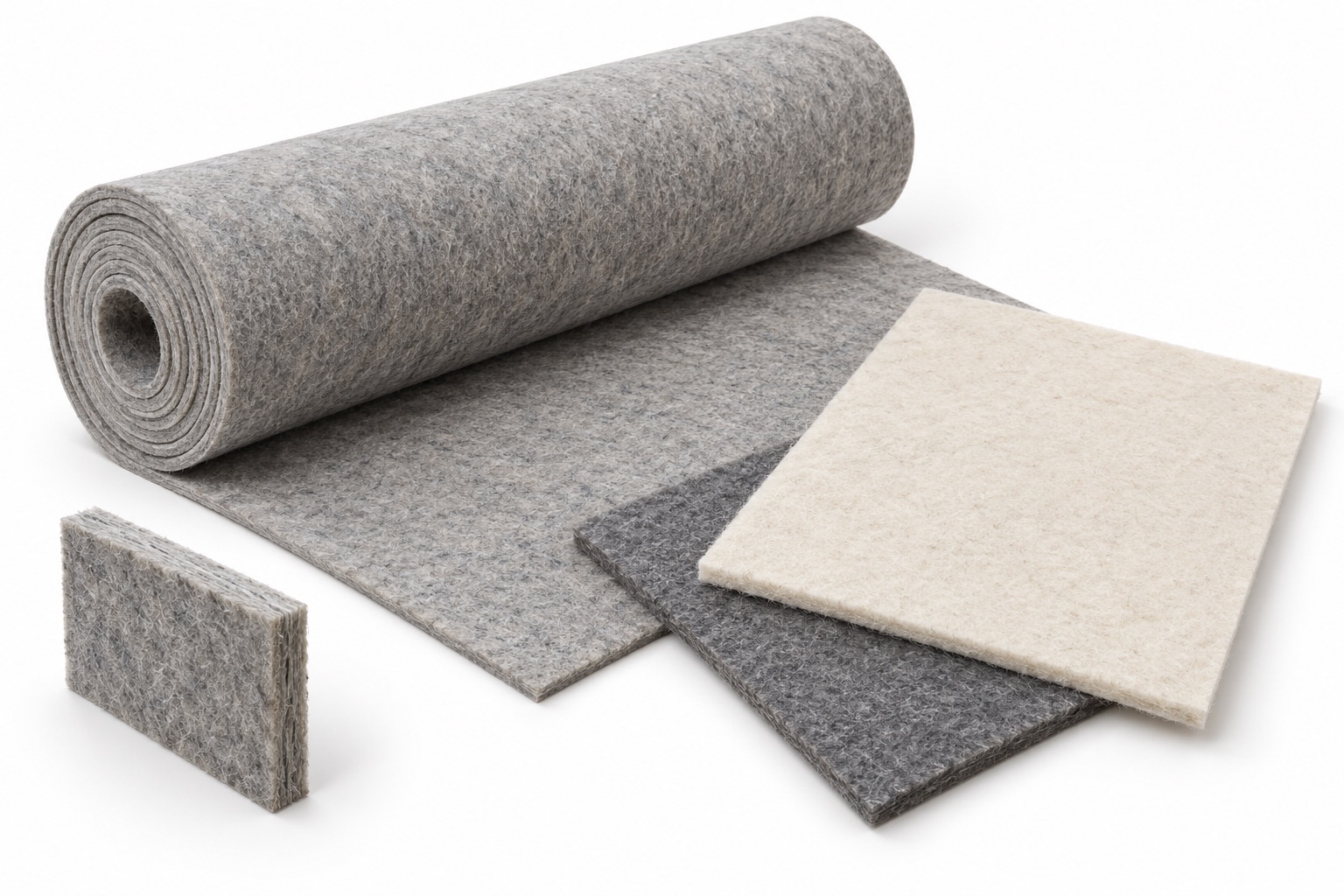
- Sheets and panels: custom dimensions, thickness, color, face, and installation context.
- Strips and rolls: width, length, edge, backing, and delivery format.
- Cut parts: gaskets, seals, washers, rings, pads, and other drawing-led shapes.
- Finished products: construction, branding, and packaging alongside material choice.
How should felt sheet and roll quantities be specified?
State whether the quantity means finished pieces, sheets, roll length or total area. Include units, sheet dimensions or roll width, and the required delivery format so the amount can be reviewed on the same basis. For continuous material or cut lengths, identify any allowed joins and use the roll and cut-length specification notes.
Material questions to resolve
Tell us what the felt touches and what it must do: cushion, protect, separate, polish, provide an interface, or serve a defined acoustic or decorative role. Fiber composition, density, thickness, surface, color, and backing are reviewed against that function. Temperature, moisture, movement, compression, cleaning, and chemical contact can change the appropriate choice.
Record material values with units and methods
Copy the required value, unit, tolerance, and test method from the approved specification. Identify open items as “for review.”
| Property | What to identify |
|---|---|
| Areal mass | Mass per area, commonly g/m². Specify the required value and sampling or conditioning method. |
| Bulk density | Mass per volume, with a unit such as kg/m³ or g/cm³. Keep this separate from mass per area. |
| Thickness | Value, tolerance, and the measurement method, including applied pressure where relevant. |
| Firmness | The agreed test and acceptance criteria, or an identified reference sample if the requirement is qualitative. |
When areal weight and thickness are known for the same construction and measurement conditions, use the felt density and areal weight calculator to check the unit conversion. Keep calculated values separate from measured evidence and specified acceptance limits.
Why identify thickness measurement conditions?
ASTM D1777-26 notes that measured textile thickness depends on applied pressure. Agree a method appropriate to the material before comparing values. ASTM D3776/D3776M addresses fabric mass per unit area, a different quantity from volume density.
Sample and specification path
Send a drawing or sample where available. A sample review can check feel, surface, cut edge, dimensions, installation, or other agreed criteria before production. Use the felt part sample approval checklist and review record to identify the governing drawing, proposed construction, measured results and open actions. Material grade, tolerances, test evidence, and availability are confirmed for the individual project.
Continue by application
Explore industrial felt and acoustic felt, or go to custom felt fabrication for processing. For defined components see gaskets, seals, washers, strips and tape, and polishing wheels.
Send a B2B material inquiry with the application, custom dimensions, quantity, and destination.