Feltova reviews custom felt seals for defined assemblies and product applications. Share the drawing, sample, dimensions, and working conditions so the material and fabrication path can be assessed before supply.
Request a custom quote · Quotation checklist
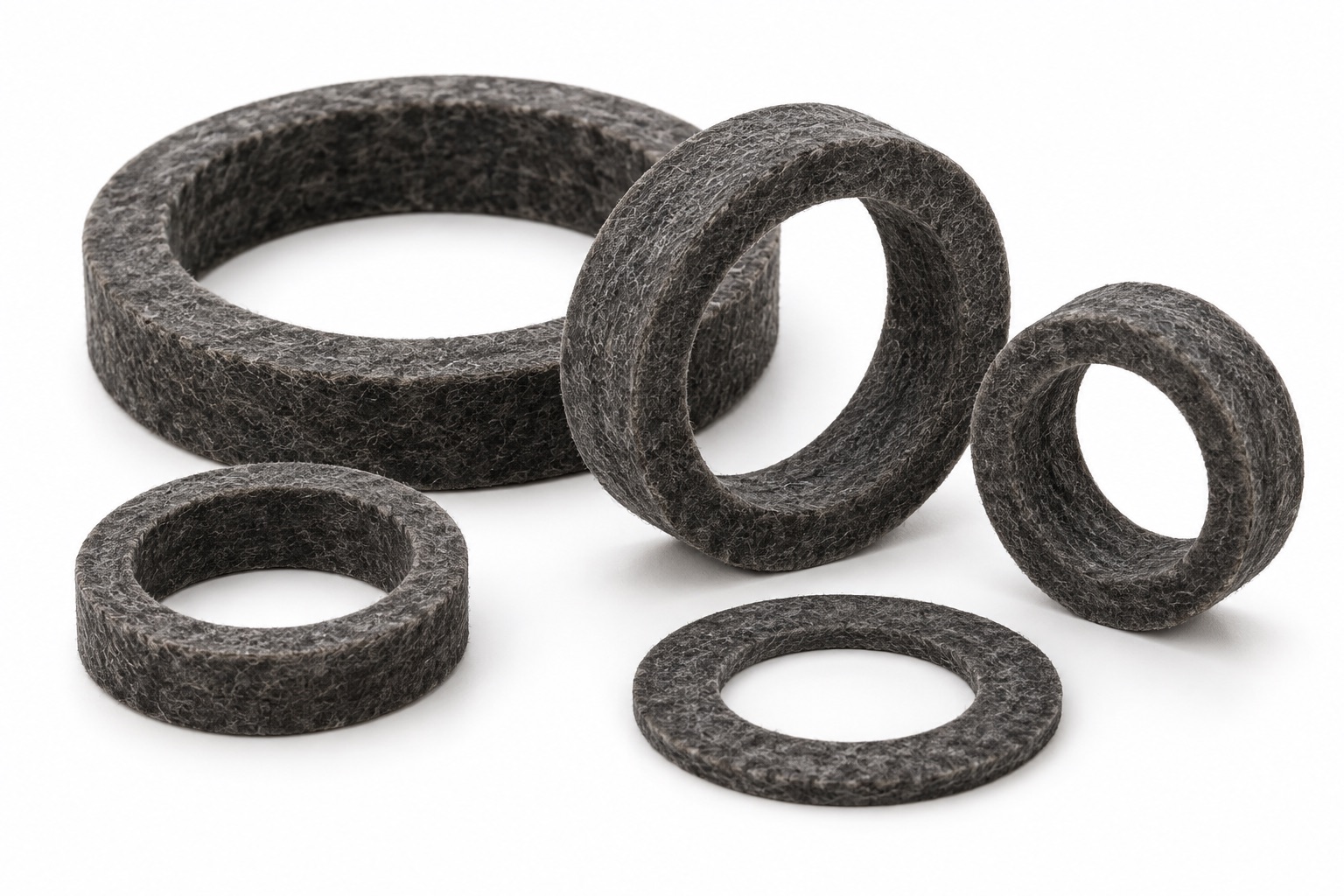
What is a felt seal?
A felt seal is a felt component positioned at an assembly interface to meet a defined retention, exclusion, or protection requirement. Its shape may be a ring, strip, or custom outline. The function, contact surfaces, movement, and medium determine the specification; a felt seal is not automatically equivalent to a pressure-rated elastomer seal.
Specify the seal’s function and operating conditions
Describe what the felt part must prevent, retain, or protect and where it sits in the assembly. Identify the shaft, housing, contact surfaces, movement, compression, temperature, moisture, and any oil, dust, or other medium involved. The part name alone does not establish suitability or sealing performance.
- Flat seals and ring-shaped felt parts for defined interfaces.
- Protective or separation components for specified assemblies.
- Oil-contact requirements reviewed from a drawing or sample.
- Custom outlines with holes, slots, or backing specified for review.
Provide dimensions and installation details
Include inside and outside dimensions, thickness or section, tolerances, mating-component dimensions, and how the part is retained. For a circular component, use the ring dimension checklist. Identify the drawing revision and critical fit dimensions.
Label a sample as approved, worn, or conceptual. Assembly photos help explain installation, but they do not replace confirmed measurements. Include material preference, quantity, packaging, destination, and requested timing.
Agree the material and sample validation
The geometry and working conditions guide review of the material, cutting route, prototype scope, and inspection points. See felt materials and formats if material selection is still open.
State the required test method and acceptance criteria when leakage, retention, wear, or another performance requirement matters. Sample fit and suitability must be checked against the actual assembly; a generic ring image or material label is not evidence of performance. Confirm the material specification and drawing revision alongside the sample approval. Use the sample approval checklist and fillable review record to record requirements separately from observations and unresolved actions.
Felt seal or felt gasket: which brief should I send?
Describe the assembly, contact surfaces and required function; terminology alone does not establish suitability. Use the felt gasket vs felt seal buyer guide to compare the information needed, then prepare the custom felt part RFQ brief.
Related felt component paths
- Custom felt oil seals for oil-contact assemblies with defined validation criteria.
- Custom felt rings for circular components.
- Custom felt gaskets for defined interface and cushioning parts.
- Custom felt washers and spacers for ring and assembly formats.
- Custom felt fabrication for broader cut-part requirements.
- Industrial felt manufacturer for application and inquiry guidance.
Send an inquiry for a custom felt seal and include the dimensions and conditions you can provide.
Felt seal sourcing FAQ
What should I provide for a shaft-contact felt seal?
Provide shaft and housing dimensions, the felt section and retention method, movement or speed conditions, contact requirements, lubricant or medium, and temperature conditions. Identify the drawing revision and how fit and function will be checked. For oil-contact assemblies, see the felt oil-seal inquiry checklist.
Can a worn felt seal be used as the only size reference?
A worn sample can help explain the part, but wear, compression, or contamination may change its dimensions and condition. Identify its condition and provide the mating-component measurements or approved drawing wherever available. Record unresolved dimensions before approving a replacement sample.
How do I approve a replacement felt seal?
Agree the material, drawing revision, dimensions, installation conditions, and any function or leakage test before sampling. Use the sample approval record to document results and open actions. A dimensional match alone does not prove application performance.